
Understanding how penetration testing works is important for organizations that want to identify security weaknesses before attackers can exploit them.
Penetration testing, often called pentesting, is an authorized security assessment in which security professionals simulate realistic attack techniques against systems, applications, networks, APIs, cloud environments, or other defined assets.
Unlike simply running an automated vulnerability scanner, a penetration test can involve manual investigation, validation, controlled exploitation, evidence collection, risk assessment, and remediation guidance.
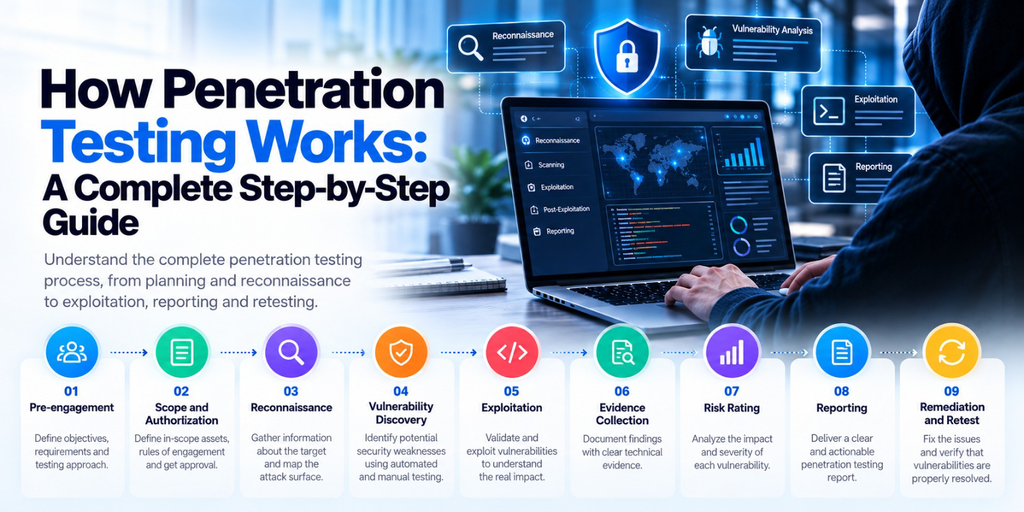
A typical engagement follows a structured process:
Pre-engagement → Scope → Reconnaissance → Vulnerability Discovery → Exploitation → Evidence Collection → Risk Assessment → Reporting → Remediation → Retesting
The exact methodology can vary depending on the environment, testing objectives, technology stack, and agreed scope.
What Is Penetration Testing?
Penetration testing is a controlled and authorized attempt to identify and validate security weaknesses in a technology environment.
The objective is not simply to find as many vulnerabilities as possible. A professional assessment aims to determine:
- What security weaknesses exist?
- Can they actually be exploited?
- What could an attacker potentially access?
- Which systems or data could be affected?
- How serious is the issue?
- How can the organization remediate it?
- Has the vulnerability been properly fixed?
Penetration testing may be performed against:
- Web applications
- APIs
- Mobile applications
- External networks
- Internal networks
- Cloud environments
- Wireless networks
- Authentication systems
- Infrastructure
- Specific business applications
Muster Security approaches penetration testing as a structured security process, where the scope and testing objectives are established before technical testing begins.
How Penetration Testing Works
Although methodologies differ between providers, a professional penetration testing process generally follows several stages.
1. Pre-Engagement
The first stage is planning.
Before any testing takes place, the organization and security provider establish the purpose of the engagement.
Important questions include:
- Why is the test being performed?
- What assets need to be tested?
- What type of testing is required?
- What are the testing dates?
- Who are the authorized contacts?
- Are there production systems involved?
- Are there restrictions on testing techniques?
- What deliverables are expected?
This stage prevents misunderstandings and helps ensure that security testing is conducted in a controlled manner.
2. Scope and Authorization
Authorization is one of the most important parts of penetration testing.
Security professionals should only test systems that they have explicit permission to assess.
The scope may define:
- Domains
- IP addresses
- Applications
- APIs
- Cloud resources
- Mobile applications
- Network ranges
- User accounts
- Testing environments
- Testing windows
- Out-of-scope systems
For example, an organization may authorize testing of:
app.example.com
but specifically exclude:
production-api.example.com
The penetration testing team must respect those boundaries.
A clearly defined scope also makes the final report more meaningful because the organization knows exactly what was assessed.
3. Reconnaissance
Once authorization and scope are established, testers begin gathering information about the target.
This stage is commonly called reconnaissance.
Depending on the engagement, testers may identify:
- Domains and subdomains
- IP addresses
- Technologies
- Application frameworks
- Public services
- API endpoints
- Authentication mechanisms
- Application functionality
- Network services
- Publicly available information
Reconnaissance helps testers understand the target’s attack surface before deeper testing begins.
For an external penetration test, this may include examining what an attacker could discover from outside the organization’s network.
For an authenticated web application assessment, testers may also map application functionality and user workflows.
4. Vulnerability Discovery
After understanding the attack surface, the penetration testing team begins looking for potential weaknesses.
Testing can involve both automated tools and manual techniques.
Potential areas include:
Authentication
Testing whether authentication controls can be bypassed or abused.
Authorization
Determining whether users can access functionality or information beyond their intended permissions.
Input validation
Testing how applications process user-controlled input.
Session management
Examining session handling, expiration, cookies and related controls.
Security configuration
Looking for weaknesses caused by insecure configurations or exposed services.
Business logic
Testing whether application workflows can be manipulated in unintended ways.
APIs
Examining authentication, authorization, input handling and data exposure.
Automated tools can help identify potential vulnerabilities efficiently, but their results often require human validation.
5. Exploitation
This is one of the stages people commonly associate with penetration testing.
During exploitation, authorized testers attempt to determine whether identified weaknesses can actually be abused.
The objective is controlled validation—not causing unnecessary damage.
For example, if a tester identifies a potential authorization weakness, they may attempt to determine whether one authorized user can access another user’s resources.
If successful, the tester can demonstrate the security impact while avoiding unnecessary modification or destruction of data.
This distinction is important.
A vulnerability scanner might report:
Potential access-control vulnerability.
A penetration tester may be able to demonstrate:
The vulnerability allows an authenticated user with one level of access to retrieve information belonging to another user.
The second finding provides significantly more context for remediation and risk assessment.
6. Evidence Collection
During testing, security professionals collect evidence supporting their findings.
Evidence may include:
- Screenshots
- Request and response information
- Affected URLs
- Relevant application behavior
- Test results
- Reproduction steps
- Technical observations
Evidence allows development and security teams to understand what happened and reproduce the issue where appropriate.
Professional testers should also avoid collecting unnecessary sensitive information.
The principle should be:
Collect enough evidence to demonstrate the vulnerability without unnecessarily exposing sensitive data.
7. Risk Rating
After vulnerabilities are validated, they need to be prioritized.
Not every security issue represents the same level of risk.
Risk assessment may consider factors such as:
- Exploitability
- Potential impact
- Authentication requirements
- User interaction
- Data exposure
- Business impact
- Privilege level
- Attack complexity
Many organizations use standardized approaches such as CVSS alongside contextual business risk.
For example, an issue affecting a public-facing authentication system may deserve a different remediation priority from a low-impact informational configuration finding.
The goal is to help organizations understand which issues should be addressed first.
8. Reporting
A penetration test should produce a clear and actionable report.
A typical report may include:
Executive Summary
A high-level overview designed for management and business stakeholders.
Scope
A description of what was tested.
Methodology
An explanation of how the assessment was conducted.
Findings
Detailed descriptions of identified vulnerabilities.
Severity
Risk classification for each finding.
Evidence
Supporting technical evidence.
Impact
An explanation of what could happen if the vulnerability remains unresolved.
Remediation
Recommended actions for addressing the issue.
A good report should be understandable to both technical and non-technical stakeholders.
9. Remediation
The penetration testing process doesn’t end when the report is delivered.
The next step is remediation.
Development, IT and security teams can use the findings to prioritize fixes.
For example:
Finding: Broken access control
Impact: Unauthorized access to another user’s information
Recommendation: Enforce server-side authorization checks for every object request.
The remediation process may involve:
- Code changes
- Configuration changes
- Access-control improvements
- Authentication updates
- Infrastructure changes
- Security policy changes
The appropriate fix depends on the root cause of the vulnerability.
10. Retesting
After remediation, the penetration testing team can perform a retest.
The purpose is to verify whether the reported vulnerabilities have been properly addressed.
The workflow becomes:
Finding → Remediation → Retest → Validation
A retest may confirm that:
- The original vulnerability is fixed
- The vulnerability is partially fixed
- The vulnerability remains exploitable
- The remediation introduced another issue
Organizations should confirm before an engagement whether retesting is included in the provider’s scope.
Penetration Testing Methodology
A professional penetration testing methodology should be systematic rather than simply running a collection of security tools.
A simplified methodology looks like this:
1. Define objectives
↓
2. Establish authorization and scope
↓
3. Understand the attack surface
↓
4. Identify potential vulnerabilities
↓
5. Manually validate findings
↓
6. Safely demonstrate impact
↓
7. Document evidence
↓
8. Assess risk
↓
9. Report findings
↓
10. Remediate and retest
Different environments may require additional stages or specialized testing procedures.
Automated Penetration Testing Process vs Manual Testing
Automation can significantly improve the efficiency of security testing, particularly when organizations have large attack surfaces.
An automated penetration testing process may help with tasks such as:
- Asset discovery
- Port scanning
- Vulnerability identification
- Configuration checks
- Repeated security checks
However, automation has limitations.
It may struggle to understand:
- Complex business logic
- Context-dependent authorization
- Application-specific workflows
- Multi-step attack paths
- Certain logic flaws
Manual testing adds human analysis to investigate potential weaknesses and validate their real-world impact.
For this reason, many security programs use automation as part of a broader testing methodology rather than treating automated scanning as a complete replacement for expert testing.
What About an AI Penetration Testing Process?
AI can increasingly assist security teams with activities such as:
- Security analysis
- Finding prioritization
- Pattern recognition
- Test-case generation
- Report assistance
- Large-scale data analysis
However, AI-assisted security testing still needs appropriate controls, human oversight and authorization.
An AI penetration testing process should not be interpreted as automatically granting permission to test systems. Scope, authorization, safety controls and human review remain important.
AI can complement security professionals, but organizations should evaluate what the technology actually performs rather than assuming that an AI-powered tool provides the same coverage as a full expert-led penetration test.
Continuous Pentesting Process
Traditional penetration testing often occurs at specific intervals or after significant application changes.
A continuous pentesting process takes a more recurring approach.
This can be useful for organizations that:
- Deploy frequently
- Continuously change infrastructure
- Operate large applications
- Have rapidly changing attack surfaces
- Want recurring security validation
Continuous testing can help identify newly introduced security weaknesses sooner, but it should still operate within clearly defined authorization and testing boundaries.
How Often Should Penetration Testing Be Performed?
The appropriate testing frequency depends on the organization’s risk profile, technology changes and applicable requirements.
Testing may be appropriate:
- Periodically
- After major application changes
- Before important launches
- After significant infrastructure changes
- Following major security incidents
- When entering new regulatory environments
Organizations with frequent deployments may also benefit from integrating security testing into their broader software development and security processes.
What Makes a Penetration Test Effective?
A useful penetration test isn’t necessarily the one that produces the longest vulnerability list.
Effective testing should provide:
Clear scope
The organization understands exactly what was tested.
Qualified testing
The assessment uses appropriate techniques for the environment.
Manual validation
Potential vulnerabilities are investigated rather than blindly reported.
Actionable findings
Development teams can understand what needs to change.
Risk context
The organization can prioritize remediation.
Retesting
Fixes can be validated after remediation.
This helps turn penetration testing from a compliance exercise into a practical security improvement process.
Start Your Penetration Testing Journey with Muster Security
Understanding how penetration testing works helps organizations make better decisions about their security testing strategy.
A structured process—from authorization and reconnaissance through exploitation, reporting and retesting—provides a clearer picture of security weaknesses and their potential impact.
Muster Security provides penetration testing services designed around defined scope, structured methodology, actionable reporting and security validation.
If your organization is evaluating its application, API, network or infrastructure security, you can learn more about Muster Security penetration testing services.
You can also explore the Muster Security testing process to understand how an engagement can be structured from initial scope definition through reporting and remediation.
The goal isn’t simply to find vulnerabilities—it is to understand, prioritize and remediate security weaknesses before they become bigger problems.
Frequently Asked Questions
1. How does penetration testing work?
Penetration testing generally involves planning, authorization, scoping, reconnaissance, vulnerability discovery, controlled exploitation, evidence collection, risk assessment, reporting, remediation and retesting.
2. Is penetration testing the same as vulnerability scanning?
No. Vulnerability scanning primarily uses automated tools to identify potential weaknesses. Penetration testing can include manual investigation and controlled exploitation to validate security issues.
3. Is penetration testing safe?
When properly authorized and planned, penetration testing is designed to assess security in a controlled manner. Testing rules should define what techniques are permitted and what systems are excluded.
4. What is tested during a pentest?
Depending on the engagement, testers may assess web applications, APIs, mobile applications, networks, cloud infrastructure, authentication, authorization and business logic.
5. Does penetration testing find every vulnerability?
No security assessment can guarantee that every vulnerability will be discovered. Results depend on scope, methodology, available access, technology and testing time.
6. What happens after a penetration test?
The organization receives findings and remediation recommendations. After fixes are implemented, a retest can be performed to validate the remediation.
7. Can AI replace penetration testers?
AI can assist with certain security-testing and analysis tasks, but organizations should evaluate AI capabilities carefully. Human expertise, authorization, scope management and validation remain important parts of professional security testing.
8. What is continuous pentesting?
Continuous pentesting refers to recurring security testing designed to identify weaknesses as an organization’s applications and infrastructure change over time.
9. How long does penetration testing take?
The duration depends on the scope and complexity of the environment. A small application can require substantially less time than a large environment containing multiple applications, APIs, user roles and infrastructure components.
10. Why is retesting important?
Retesting confirms whether previously identified vulnerabilities have actually been fixed and helps organizations avoid assuming that remediation was successful without verification.